Voice cloning software can now create a usable synthetic version of a real voice from a short recording, but the best tool depends heavily on what you are trying to make. A YouTuber cloning their own voice for backup narration needs a different workflow from a developer building a voice agent, a podcast editor fixing one sentence, or an enterprise team that needs consent, watermarking, and access controls.
This guide compares the best voice cloning software for creators, developers, editors, and business teams in 2026. It focuses on real voice cloning products, not generic text-to-speech tools that only offer prebuilt voices.
Pricing and feature details were checked from official pages in July 2026. Voice cloning tools change quickly, so confirm current plan limits and consent rules before uploading a voice sample or buying a plan.
Before estimating total production cost, check our TTS pricing comparison for free tiers, paid quotas, API access, commercial-use rules, and voice-cloning availability across 12 tools.
Quick Recommendations
- Best overall voice cloning software: ElevenLabs for realistic cloning, strong TTS, dubbing, API access, and a clear upgrade path from Instant Voice Cloning to Professional Voice Cloning.
- Best for creator video workflows: LOVO AI because it combines voice cloning with a script-to-video editor, subtitles, stock assets, and a broad AI voice library.
- Best for developers and API-first teams: Resemble AI because it offers pay-as-you-go voice AI, voice clone add-ons, full API access, watermarking, and deepfake detection.
- Best for editors fixing recorded content: Descript because AI Speech and Regenerate live inside a transcript-based audio and video editor.
- Best for listening and accessibility workflows: Speechify if your main need is reading text aloud and experimenting with voice features rather than building a production cloning workflow.
For related buying paths, see our ElevenLabs alternatives, ElevenLabs vs Descript, and best TTS for podcasts guides.
Voice Cloning Software Compared
| Tool | Best For | Starting Price | Voice Cloning Type | API | Best Use Case |
|---|---|---|---|---|---|
| ElevenLabs | Most creators and prosumers | Free, paid from $6/month | Instant and Professional Voice Cloning | Yes | Realistic narration, dubbing, creator voice backup |
| LOVO AI | Creator videos and social content | Trial advertised, pricing varies | Voice cloning from about one minute of audio | Yes | YouTube, shorts, multilingual creator projects |
| Resemble AI | Developers and enterprises | Flex plan starts at $0, usage based | Rapid and Pro voice clone add-ons | Yes | Voice products, agents, security-sensitive deployments |
| Descript | Editors and podcasters | Hobbyist $16/month annual | AI Speech custom voice clones | Limited/editor-oriented | Patching dialogue, podcast edits, transcript workflows |
| Speechify | Personal listening and accessibility | Free, Premium $29/month | Voice features around reader ecosystem | Separate products | Reading, productivity, accessibility |
Voice Clone Readiness Scorecard
This is the table to use before uploading a real voice sample. It separates demo quality from production readiness. A tool can sound impressive and still be risky if consent controls, commercial rights, export workflow, or API behavior are weak.
| Tool | Realism For Narration | Fast Clone Setup | Consent And Safety Fit | Long-Form Workflow | Developer Fit | Best Buying Signal |
|---|---|---|---|---|---|---|
| ElevenLabs | Very strong | Strong | Strong when used with documented consent | Strong | Strong | Pick when the cloned voice becomes a recurring production asset |
| LOVO AI | Good for creator voiceover | Strong | Confirm project rights before client work | Good for short and mid-form video | Good | Pick when cloning is part of a video workflow |
| Resemble AI | Strong | Strong | Stronger enterprise/security posture | Good with engineering support | Very strong | Pick when API, watermarking, and governance matter |
| Descript | Good for repairs | Good inside edits | Good for owned or consented project voices | Best for patching recorded speech | Limited | Pick when you are fixing existing audio, not building a synthetic narrator |
| Speechify | Good for listening | Not the core reader use case | Confirm Studio/API terms separately | Good for consumption, weak for production cloning | Separate product path | Pick when personal listening is the actual job |
Hands-On Test Script For Voice Cloning
Do not judge a clone from one clean sentence. Use the same test script across every tool:
- a calm 30-second introduction
- one sentence with a product name, a number, and an acronym
- one energetic call to action
- one paragraph with a question and a pause
- one line with a difficult name or invented word
Then listen for four failures: unstable accent, flattened emotion, odd pauses, and pronunciation drift. If the clone only sounds good on short clean copy, it may fail in podcasts, audiobooks, courses, or ads.
What to Look for in Voice Cloning Software
The "best" voice cloning tool is not simply the one with the most realistic demo. Judge each option against five practical criteria.
Voice realism. Does the clone preserve tone, pace, accent, and emotional range, or does it sound like a generic TTS voice wearing your accent?
Clone setup. Some tools offer fast cloning from a short sample. Others require longer training data or identity checks. Fast is convenient, but higher-fidelity workflows usually have stricter verification.
Consent and safety. Responsible voice cloning tools should require consent, restrict public-figure misuse, and give teams control over who can generate audio from a clone.
Production workflow. A voice model alone is not enough. You may also need script editing, pronunciation controls, audio export, subtitles, video editing, or API access.
Commercial rights. Do not assume that a free clone can be used in paid ads, monetized YouTube videos, client work, or games. Check the plan's commercial license before publishing.
1. ElevenLabs
ElevenLabs is the strongest default recommendation for most people searching for the best voice cloning software. It combines voice cloning, realistic text-to-speech, dubbing, speech-to-speech, voice design, projects, and API access in one platform.
The official ElevenLabs pricing page lists a Free plan with 10k credits, Starter at $6/month with a commercial license and Instant Voice Cloning, Creator at $22/month with Professional Voice Cloning, Pro at $99/month, Scale at $299/month, and Business at $990/month. That makes the upgrade path unusually clear: test voice quality for free, start commercial work at Starter, then move to Creator when professional cloning matters.
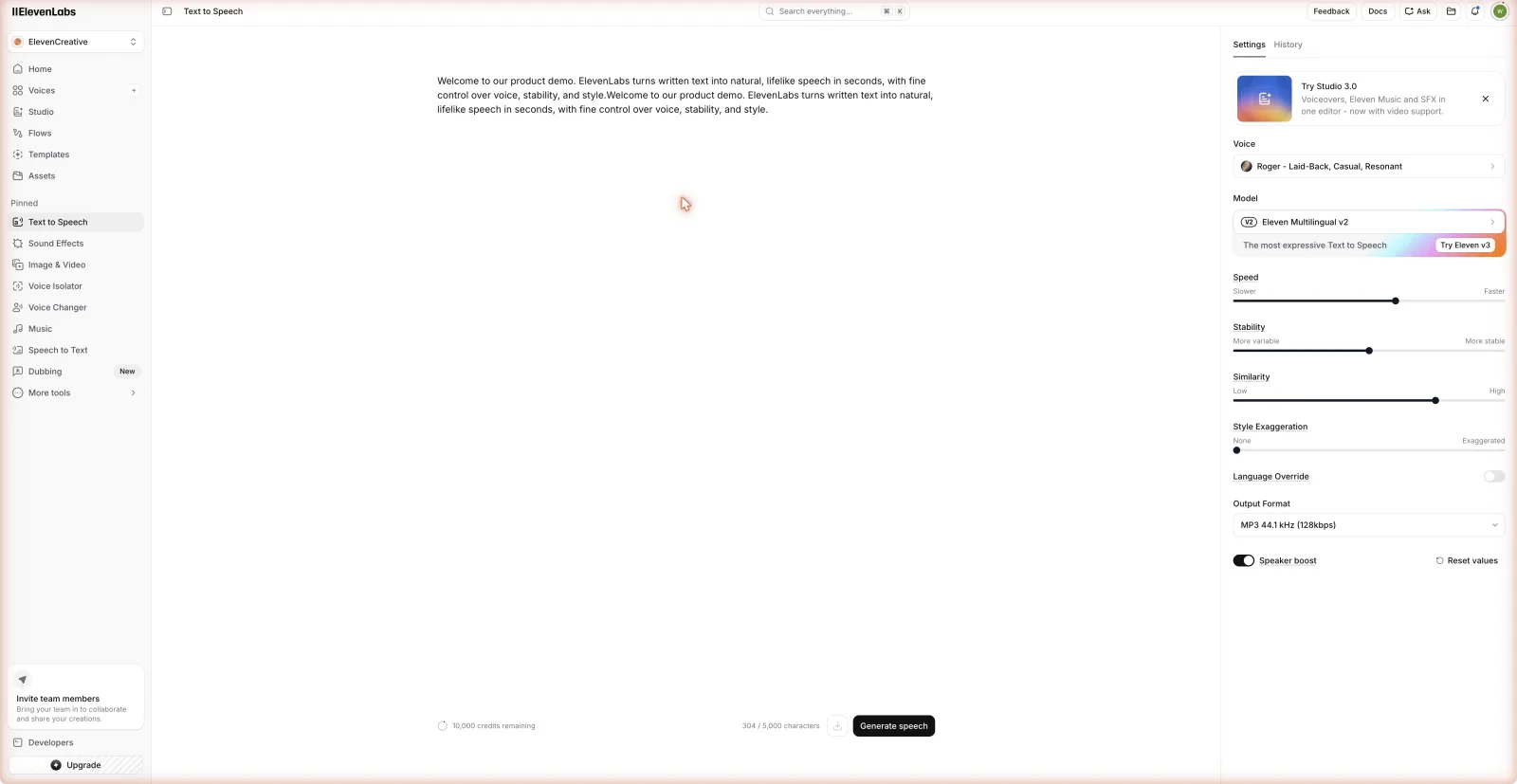
Why it stands out: ElevenLabs is especially good when cloning quality matters as much as workflow. Instant Voice Cloning is useful for quick creator tests. Professional Voice Cloning is the better path for long-term narration, audiobook-style work, brand voice, or recurring production.
Pricing and usage note: Starter is the first serious paid tier for most solo creators because it adds commercial rights and Instant Voice Cloning. Creator is the more natural tier when the cloned voice becomes part of a recurring content system, such as a weekly YouTube channel, course library, podcast intro package, or audiobook workflow. For one-off testing, the free tier is enough to compare voice fit, but do not treat it as a production plan.
Best for: YouTubers, podcasters, audiobook narrators, course creators, localization teams, app builders, and creators who need a high-quality clone they can use across many projects.
Limits: Credit usage can climb quickly for long-form audio. Professional Voice Cloning requires more commitment than a quick test. If you mainly need a video editor or transcript editor, ElevenLabs may feel like only one part of the stack.
Choose ElevenLabs if: your top priority is realistic AI speech, high-quality cloning, multilingual generation, dubbing, and a platform that can scale from creator use to API workflows.
For a wider market view, compare it against other tools in our ElevenLabs alternatives guide.
2. LOVO AI
LOVO AI is the best voice cloning option for creators who want a full content workflow around the clone. Its Genny editor combines AI voices, voice cloning, script editing, subtitles, stock assets, and video production features. That makes it more creator-oriented than a pure voice API.
LOVO's official homepage describes 500+ voices in 100 languages, voice cloning from about one minute of audio, AI dubbing, API access, and a 14-day Pro trial with no credit card required. Since its pricing page was not separately accessible in this collector, treat specific plan limits as something to confirm before buying.
Why it stands out: LOVO is useful when the clone is part of a larger video production workflow. A creator can write a script, generate voice, add captions, assemble visuals, and export social content without moving between several apps.
Pricing and usage note: LOVO is easiest to justify when its editor replaces at least one other tool in your stack. If you only need a cloned voice file, compare the output directly against ElevenLabs before paying. If you also need subtitles, social video assembly, and multilingual creator assets, the value is in the combined workflow rather than cloning alone.
Best for: YouTubers, short-form video creators, marketers, course creators, and small teams that want voice cloning plus a lightweight editing canvas.
Limits: If your only goal is the most realistic standalone clone, ElevenLabs is still the safer benchmark. If you need API-first infrastructure, Resemble AI or ElevenLabs may be a better fit.
Choose LOVO if: you want voice cloning inside a creator workflow rather than a standalone voice model.
For more context on the matchup, see ElevenLabs vs LOVO.
3. Resemble AI
Resemble AI is the best fit for developers, enterprise teams, and security-conscious voice AI projects. It is not just a voice cloning app. Resemble positions itself around generative voice, identity verification, watermarking, and deepfake detection.
The official Resemble AI pricing page lists a Flex plan that starts at $0 and uses pay-as-you-go credits. It includes access to all voice AI models, voice cloning capabilities, full API access, and credits that do not expire. The same page lists team seats at $20/month per user, rapid voice clone at $2/month per voice, Pro voice clone at $5/month per voice, voice design at $2/month per voice, and TTS usage at $0.0005 per second. Enterprise is custom and includes volume discounts, higher concurrency, SLA, SOC 2, custom model training, SSO/SAML, support, and on-premise deployment.
Why it stands out: Resemble AI is built for production systems. If you are adding cloned voice to an app, customer workflow, internal product, game, or voice agent, API access and governance matter as much as audio quality.
Pricing and usage note: Resemble's Flex model is attractive when usage is uneven because you can start without a fixed monthly platform fee and then pay for generation, seats, and voice add-ons as the project grows. That said, teams should model cost by seconds of generated audio, number of cloned voices, users, and detection needs before choosing it over a flat monthly creator tool.
Best for: developers, startups, contact-center products, media companies, enterprise teams, voice agents, and projects where watermarking or deepfake detection matters.
Limits: It is less beginner-friendly than ElevenLabs or LOVO. The pricing model is powerful but requires understanding usage rates and add-ons.
Choose Resemble AI if: you need voice cloning as infrastructure rather than a creator-only tool.
4. Descript
Descript is not the best pure voice cloning tool, but it is one of the best tools for editors who need cloning inside an audio or video workflow. Its AI Speech features are designed to regenerate or patch spoken content inside a project.
The official Descript pricing page lists Hobbyist at $16/month billed annually ($24 monthly) and Creator at $24/month billed annually ($35 monthly). The page includes AI Speech with custom voice clones, stock AI speakers, and Regenerate features in the broader editing suite.
Why it stands out: Descript solves a different problem from ElevenLabs. If you recorded a podcast, interview, or talking-head video and need to fix one sentence without re-recording, Descript is extremely practical. You edit by transcript, regenerate a phrase, clean audio, remove filler words, and keep the project in one place.
Best for: podcasters, interview editors, course creators, YouTubers, and teams that already work from recorded speech.
Limits: Descript is not a large AI voice library or API-first cloning platform. Its cloning use case is mostly about your own voice or consented voices inside edits.
Choose Descript if: you need voice cloning for repair, not full synthetic narration.
For a deeper workflow comparison, read ElevenLabs vs Descript.
5. Speechify
Speechify belongs on this list with a caveat. It is better known as a text-to-speech reader than as a production voice cloning platform. For users who want personal listening, accessibility support, and reader-style workflows, that can be exactly the point.
The official Speechify pricing page lists a Free plan and Premium at $29/month. The Premium page describes natural voices, 60+ languages, faster listening, Scan & Listen, summaries, integrations, voice typing, AI podcasts, and Voice AI Assistant. Those are strong reader and productivity features.
Why it stands out: Speechify is useful if the voice problem is tied to reading, accessibility, or productivity. It can be a better choice than ElevenLabs for people who want documents, PDFs, articles, or emails read aloud across devices.
Best for: students, professionals, accessibility users, dyslexia and ADHD support, productivity workflows, and long-form listening.
Limits: Treat Speechify as a reader ecosystem first. If your goal is professional voice cloning for published narration, compare it carefully against ElevenLabs, LOVO, and Resemble AI.
Choose Speechify if: your main use case is listening to content rather than producing cloned voiceovers.
How to Choose the Best Voice Cloning Software
Use this decision path:
- You want the most realistic cloned narration: choose ElevenLabs first.
- You create YouTube videos or social content: choose LOVO if you want voice cloning plus editing and captions.
- You build apps, agents, or enterprise workflows: choose Resemble AI for API access, pay-as-you-go usage, watermarking, and governance.
- You edit podcasts or recorded videos: choose Descript for AI Speech and transcript-based repair.
- You mostly listen to text: choose Speechify.
If you are cloning a voice for podcasts, also compare the options in our best TTS for podcasts guide. If the clone is for YouTube narration, our best AI text-to-speech for YouTube guide may be the better buying path.
Voice Cloning Software vs Voice Cloning App
Many searches for "best voice cloning app" are really asking for the same thing as "best voice cloning software," but the buyer profile is slightly different. An app buyer usually wants a fast browser or mobile workflow: upload a sample, generate a short script, and share the result. A software buyer is more likely to care about commercial rights, team seats, API access, repeatable brand voices, audit trails, and long-term production cost.
Use this split before you choose:
| Buyer Intent | Better Fit | Why It Matters |
|---|---|---|
| Quick personal experiment | Speechify or a free ElevenLabs test | Low setup friction matters more than deep controls. |
| Creator voiceover channel | ElevenLabs or LOVO | You need commercial rights, reliable output, and repeatable voice settings. |
| Podcast or video repair | Descript | The cloned voice sits inside an editing workflow. |
| Product or API integration | Resemble AI or ElevenLabs | Developers need latency, documentation, usage controls, and scalable generation. |
| Enterprise brand voice | Resemble AI, WellSaid, or ElevenLabs Enterprise | Governance, permissions, security, and consent records matter more than novelty. |
For most public-facing work, treat app-style tools as trials and software-style tools as production systems. The moment a cloned voice becomes part of a paid course, ad, YouTube channel, audiobook, customer support flow, or product feature, you should care about licensing, consent logs, export quality, and who can access the voice model.
AI Voice Cloning Use Cases by Channel
The best AI voice cloning tool changes by channel. A YouTube creator needs consistent narration that can survive weekly script changes. ElevenLabs is usually the strongest starting point because it combines voice quality, cloning, multilingual options, and API access. A podcast producer may need cloning only to repair a sentence after recording, which makes Descript more practical than a standalone voice generator. A training team may care less about emotional performance and more about brand safety, reviewer workflows, and whether the same voice can be reused across a course library.
Audiobooks deserve extra caution. A cloned narrator can make revisions easier, but rights, platform disclosure rules, and listener trust matter. If you plan to use AI voice cloning for long-form narration, document consent, keep source files, and confirm that your distribution platform allows synthetic or cloned narration before producing the full book.
Voice Cloning Ethics and Consent
Voice cloning should only be used with consent. Do not clone a public figure, coworker, client, family member, actor, or creator without clear permission. Even when a tool technically allows a clone, your legal and ethical responsibility does not disappear.
For business use, keep written consent records, control who can access the cloned voice, avoid deceptive uses, and check whether the platform offers verification, watermarking, usage logs, or enterprise permissions. For public content, disclose AI voice use when it affects trust, sponsorship, or identity.
Consent And Production Checklist
Before a cloned voice goes public, keep a simple record with:
- who the speaker is
- when consent was granted
- what the voice can be used for
- whether ads, client work, paid courses, games, or audiobooks are allowed
- which tool and plan created the audio
- who can access the cloned voice
- whether the final content needs AI voice disclosure
This matters even if you are cloning your own voice. A casual experiment can become a commercial asset later, and clean records prevent avoidable disputes with clients, collaborators, platforms, or talent.
If you are not ready for a paid cloning workflow yet, compare the limits and safety trade-offs in our guide to the best free voice cloning software before uploading voice samples.
Related guide: See ElevenLabs vs Murf if you are choosing between self-serve cloning and team voiceover production.
Related guide: See LOVO alternatives if LOVO voice cloning or creator workflow limits are the reason you are switching.
Related guide: See ElevenLabs review before choosing it as your default voice cloning platform.
Related guide: See ElevenLabs vs Resemble AI if you are deciding between creator-friendly cloning and API-first voice infrastructure.
Frequently Asked Questions
What is the best voice cloning software overall?
ElevenLabs is the best overall choice for most creators because it combines realistic voice cloning, text-to-speech, dubbing, and API access. Resemble AI is stronger for developer and enterprise workflows, while LOVO is better for video-first creators.
Which voice cloning software is best for YouTube creators?
LOVO is the most convenient choice if you want voice cloning, captions, and video assembly in one place. ElevenLabs is better if the YouTube channel depends on the most realistic narration quality.
Which voice cloning tool has the best API?
Resemble AI and ElevenLabs are the strongest API-focused options. Resemble AI is especially attractive for teams that care about pay-as-you-go usage, watermarking, and deepfake detection.
Is voice cloning legal?
Voice cloning can be legal when you have permission to use the voice and follow the platform's terms. Cloning someone without consent can create legal, ethical, and platform-policy problems.
Can I clone someone else's voice?
You should only clone another person's voice with clear consent and the rights to use that voice in your project. For commercial use, get written permission and check the platform's voice cloning policy.
What is the best voice cloning software for podcasts?
ElevenLabs is best for generating polished cloned narration. Descript is better for fixing recorded podcast lines inside an edit. Speechify is not the right choice for podcast production unless your goal is personal listening.
Is Descript a good voice cloning tool?
Descript is good for voice repair inside recorded audio and video projects. It is not the best choice if you want a standalone cloned narrator, large voice library, or developer API.
What is the best free voice cloning software?
Free plans are best for testing. ElevenLabs has a free plan, Resemble AI has a Flex plan that starts at $0, and LOVO advertises a Pro trial. Check current limits before assuming a free clone can be used commercially.
Short answer: ElevenLabs is the best voice cloning software for most creators, LOVO is best for video-first workflows, Resemble AI is best for developers and enterprises, Descript is best for editing recorded speech, and Speechify is best for reading and accessibility rather than production cloning.