ElevenLabs is one of the strongest AI voice platforms for realistic text-to-speech, cloning, dubbing, and API-driven audio. It is not the cheapest or simplest tool for every buyer, but it is one of the first platforms worth testing when voice quality matters.
Before estimating total production cost, check our TTS pricing comparison for free tiers, paid quotas, API access, commercial-use rules, and voice-cloning availability across 12 tools.
Pricing and feature notes were checked against official product and pricing pages in July 2026. Confirm current plan limits, credit rules, cloning terms, API pricing, and commercial rights before buying.
Quick Verdict
- Best for: realistic narration, voice cloning, dubbing, API voice, character dialogue, and creator audio.
- Not ideal for: buyers who only need basic document reading or a simple business voiceover editor.
- Strongest alternative: Murf for business narration and training workflows.
- Best video-first alternative: Fliki for script-to-video and social clips.
Related reading:
- ElevenLabs alternatives
- best free ElevenLabs alternatives
- ElevenLabs vs Murf
- ElevenLabs vs Speechify
- ElevenLabs vs Resemble AI
- Murf alternatives
- best text to speech API for developers
- best AI voice for commercial use
- best free AI text to speech
Feature Table
| Area | ElevenLabs Fit | Notes |
|---|---|---|
| Text-to-speech | Strong | Best when natural voice quality matters |
| Voice cloning | Strong | Consent and rights need careful handling |
| Dubbing | Strong | Useful for localization and video workflows |
| API | Strong | Good fit for apps and automated generation |
| Business narration | Good | Compare against Murf and WellSaid Labs |
| Simple reading | Mixed | Speechify may be easier for personal listening |
Pricing
Check the official ElevenLabs pricing page before buying. The important details are credits, commercial rights, voice cloning access, dubbing limits, API usage, team features, and whether the plan fits your expected output volume.
Voice Quality
ElevenLabs is strongest when the voice itself is the product. Narration, character reads, audiobooks, YouTube voiceover, ads, and app voices all benefit from natural pacing and expressive delivery.
Workflow
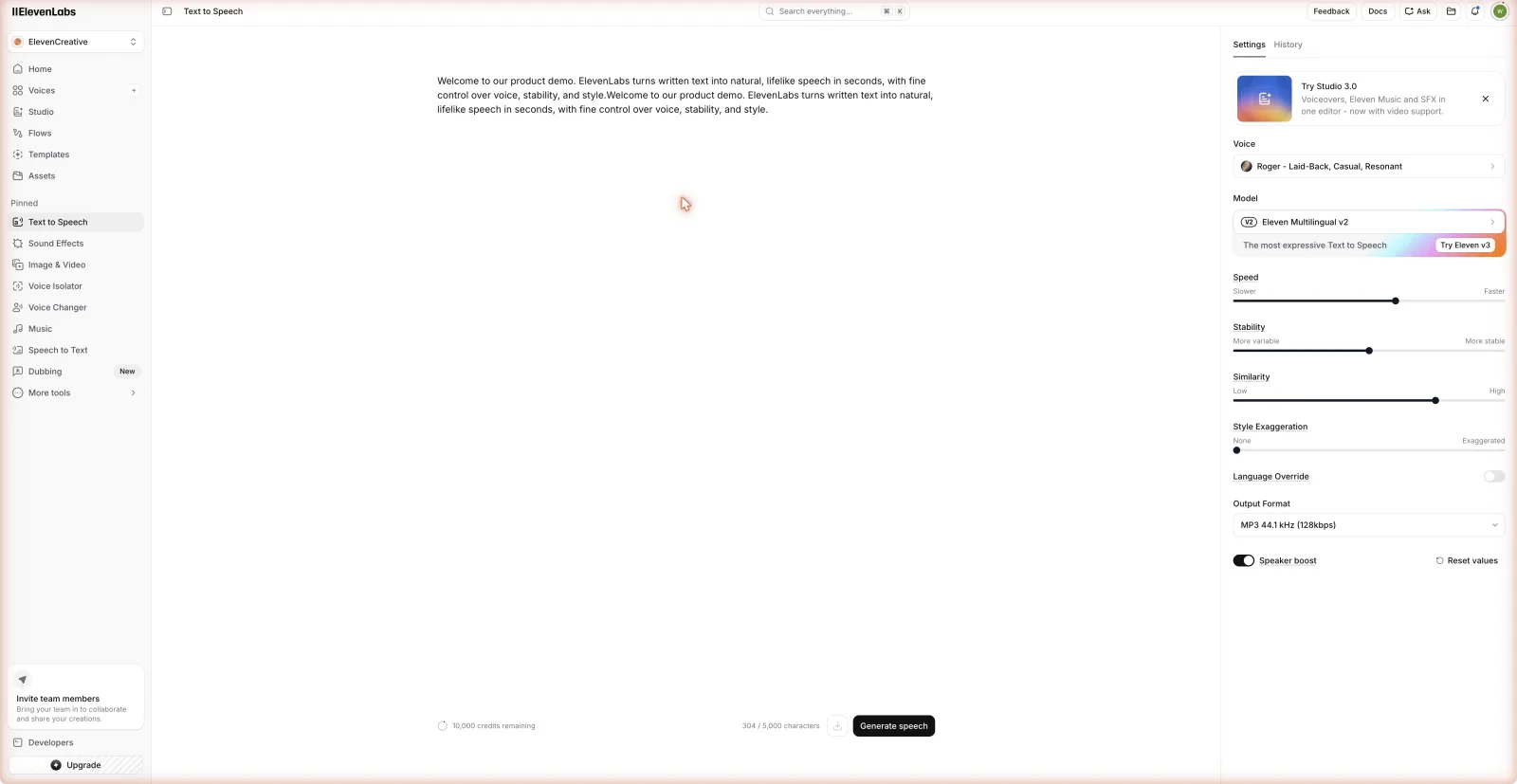
The platform works well for buyers who want to generate, revise, and reuse voices across projects. It is less ideal if you only want a simple editor for corporate slides or a mobile reader for documents.
Commercial Rights
Commercial rights are essential. Confirm the plan terms before using output in monetized videos, client work, ads, SaaS apps, games, courses, audiobooks, or phone systems. For cloning, keep explicit consent records.
Alternatives
Murf is a better first test for structured training videos and business voiceover. LOVO is useful for expressive creator work and dubbing. Fliki fits video-first teams. Speechify fits reading and accessibility workflows.
Who ElevenLabs Is Best For
ElevenLabs is best for buyers who care about the voice as a primary asset. That includes YouTube creators, audiobook producers, game developers, localization teams, ad teams, educators, and SaaS products that need recognizable or realistic speech.
It is also a strong fit for teams that need more than simple text-to-speech. Voice cloning, dubbing, speech-to-speech, and API workflows make it broader than a basic reader. That breadth is the reason it appears in so many AI voice comparisons.
Where ElevenLabs Is Less Ideal
ElevenLabs is not always the simplest choice for corporate slide narration or document listening. If you need a structured business voiceover workflow, Murf may be easier. If you need personal reading, Speechify may be easier. If you need script-to-video, Fliki may be faster.
The other tradeoff is planning. Buyers need to understand credits, generation limits, rights, cloning consent, and what happens as volume grows. The tool is powerful, but it is not something to use casually for commercial work without checking terms.
Practical Test
Before buying, generate one real script. Include a product name, a number, a question, a calm paragraph, and an energetic call to action. Then revise the script and export again. This reveals more than any homepage demo.
For API use, build a small proof of concept. Test authentication, latency, retries, error handling, logs, and cost at expected volume. If the voice will be part of a user-facing product, operational behavior matters as much as sound quality.
Alternatives to Compare
Compare Murf if the project is training, e-learning, product explainers, or business narration. Compare LOVO if expressive creator video and dubbing matter. Compare Fliki if you want captions and video templates. Compare Google Cloud TTS or OpenAI TTS if the project is developer-first.
Bottom Line
ElevenLabs is one of the best first tests for serious AI voice work. It is not automatically the best for every workflow, but it is hard to ignore when realism, cloning, dubbing, or API voice generation are priorities.
Feature Depth
The main reason ElevenLabs stands out is breadth inside AI audio. Text-to-speech is the entry point, but many buyers stay because they also need voice cloning, dubbing, speech-to-speech, API access, or a consistent voice across multiple projects.
That breadth is useful for creators who start with narration and later need localization, character dialogue, or branded voice output. It is also useful for product teams that want to test generated speech in an app before building a larger audio workflow.
Pricing Evaluation
Pricing should be evaluated by finished output, not only by the plan page. Estimate how many minutes or characters you need, how many drafts you generate, how often you revise, and whether cloned voices or dubbing are part of the workflow.
A small creator may only need a modest plan for a few videos per month. A SaaS product, audiobook workflow, or localization project may need much more careful cost modeling. The same tool can be affordable in one workflow and expensive in another.
Trust and Safety
Voice cloning makes consent important. Buyers should not treat cloning as a casual feature. Get permission, document the speaker, and make sure the intended use matches the agreement. This protects the creator, client, and audience.
For commercial work, keep records of the plan and generated assets. If a platform, client, or marketplace asks how audio was created, you should be able to answer clearly.
Best-Fit Summary
ElevenLabs is strongest when the audio needs to sound convincing and flexible. It is weaker when the buyer only needs a simple reader, a transcript editor, or a narrow corporate narration workflow. That is why it should be tested alongside Murf, Fliki, LOVO, Speechify, and cloud TTS tools rather than judged in isolation.
Practical Evaluation Scorecard
Before choosing, score each tool from 1 to 5 on voice quality, revision speed, pricing clarity, commercial rights, team workflow, and integration effort. Do not let one impressive category hide a weak production workflow. A tool with excellent voice quality but unclear rights may be risky. A tool with reliable APIs but weak emotional delivery may be wrong for creator content.
Use the same script, same reviewer, and same output environment for every test. If one sample is played through studio headphones and another through a phone speaker, the comparison is not fair. For business content, include the people who will approve the final asset. For developer products, include the engineer who will maintain the integration.
Keep notes on what went wrong. Mispronounced names, slow exports, unclear pricing, awkward pauses, and hard-to-repeat settings are not small issues. They become recurring costs when the workflow scales.
When to Reconsider
Reconsider your choice if the tool cannot handle the actual script length, if commercial rights are unclear, if pricing becomes unpredictable at normal usage, or if the approval team does not trust the output. The best AI voice tool is not the one with the most features. It is the one that reliably ships the work you need.
Voice Cloning and Consent
Voice cloning is one of ElevenLabs' most powerful features, and also one of the areas that needs the most care. Teams should get explicit consent from the speaker, define the allowed use cases, and keep that record with the project. This is important for brand voices, employee voices, actors, creators, and client work.
A cloned voice should be tested with real scripts before it becomes part of production. Some voices handle calm narration well but struggle with energetic lines, names, or long-form pacing. A good test includes normal speech, numbers, emphasis, and difficult vocabulary.
Dubbing and Localization
ElevenLabs can be a strong option for teams that want to localize videos or audio. The buyer should still test language quality with native speakers. Translation accuracy, cultural fit, lip timing, subtitle workflow, and commercial rights all matter.
For global teams, the question is not only whether a language is supported. The question is whether the output sounds trustworthy to the target audience. A technically correct voice can still feel wrong if the accent, pacing, or tone does not fit the market.
API Use Cases
Developers should test ElevenLabs with a small proof of concept before building around it. Check authentication, latency, error responses, rate limits, logging, and what happens when generation fails. If users can generate speech repeatedly, usage controls and caching become important.
For SaaS products, decide whether generated audio is stored, streamed, or created on demand. Each choice affects cost, privacy, and user experience. ElevenLabs can be a strong API option, but it needs production planning like any other infrastructure dependency.
Content Workflow
Creators should build reusable voice presets and naming conventions. Teams should record which voice was used for each project, which plan was active, and whether the audio is approved for commercial use. This keeps the workflow clean as the library grows.
The best ElevenLabs workflow is disciplined. Treat generated audio like a production asset, not a disposable experiment.
Final Pre-Publish Checklist
Before publishing with this tool choice, run a final checklist. Confirm the current pricing page, commercial rights, export limits, API limits if relevant, team access, and whether the plan covers the channel where the audio will appear. Save screenshots or notes for the plan you selected, especially for client work or paid media.
Then test a realistic production asset. Use a full script rather than a sample sentence. Include numbers, product names, pronunciation traps, and a paragraph that needs a different emotional tone. Export the file, place it into the final environment, and ask the real reviewer to approve it.
Finally, compare the total workflow time. Count script preparation, generation, revision, export, review, and any cleanup. The best tool is not always the one with the best first take. It is the one that gets approved output into production with the least risk.
Decision Notes For Different Teams
Solo creators should prioritize speed, voice quality, and predictable rights. They usually do not need the heaviest team controls, but they do need a repeatable voice style and a simple way to revise scripts.
Business teams should prioritize consistency, approval flow, pronunciation control, and documentation. A slightly slower workflow can be acceptable if it reduces brand risk and avoids repeated review problems.
Developers should prioritize API behavior, data handling, latency, cost at volume, and fallback design. A strong demo voice does not replace stable infrastructure.
Agencies should prioritize client rights, project organization, reusable settings, and export history. If a client asks how the audio was generated, the agency should be able to answer without hunting through old files.
For teams, the safest way to adopt ElevenLabs is to define approved use cases first. Separate internal experiments from public content, client deliverables, cloned voices, API features, and paid ads. Each category can have different rights, review, and documentation needs.
Team Adoption Plan
A team should not roll out ElevenLabs to everyone at once. Start with a small group, define approved use cases, and create a simple policy for cloning, dubbing, commercial work, and API experiments. That policy does not need to be heavy, but it should prevent unclear ownership.
Create a shared voice library with names, use cases, and notes. Mark which voices are approved for public content, internal drafts, ads, product audio, or experiments. This keeps the workflow cleaner as more people use the platform.
Final Scenario Check
Run one last scenario check before choosing. If the buyer is a creator, judge the final audio by listener trust and publishing speed. If the buyer is a business team, judge it by approval workflow, documentation, and whether stakeholders can request changes without restarting the project. If the buyer is a developer, judge it by operational stability, cost at volume, and how easy it is to monitor failures.
This scenario check prevents a common mistake: choosing a tool because it wins one demo while losing the real workflow. A voice product should be selected against the work it must ship every week, not against a short sample sentence.
Final Recommendation
ElevenLabs is worth testing if voice realism, cloning, dubbing, or API audio is central to your workflow. If your main need is corporate narration, compare it with Murf. If you need video templates, compare it with Fliki.
If ElevenLabs is one candidate in a broader narration stack, compare it against the other tools in our best AI narration software guide before choosing a long-term narrator.
2026 Update: Is ElevenLabs Still Worth It?
2026 update: ElevenLabs is still worth testing first if your priority is realistic AI voice, self-serve voice cloning, multilingual narration, dubbing, or API-driven audio. The clearest buying path in 2026 is simple: use the free plan to test voice quality, move to Starter when you need a commercial license and Instant Voice Cloning, consider Creator when Professional Voice Cloning matters, and only move to Pro, Scale, or Business when output volume or API quality requires it.
| Plan / Decision Point | 2026 Public Baseline | Best For | Review Verdict |
|---|---|---|---|
| Free | $0 with 10k credits/month. | Testing voices, short demos, early comparison. | Good enough to judge quality, not enough for serious commercial production. |
| Starter | $6/month with 30k credits, commercial license, and Instant Voice Cloning. | Creators who need usable commercial output. | Best entry point for most readers. |
| Creator | $22/month with 121k credits and Professional Voice Cloning. | Podcasts, audiobooks, branded voices, recurring narration. | Worth it when cloning quality matters. |
| Pro and above | Pro is listed at $99/month, with higher tiers for larger credit pools and teams. | High-volume API, higher-fidelity audio, production teams. | Buy for scale, not just curiosity. |
| Murf comparison | Murf starts from $19/month annually for Creator and is better as a team studio. | Training, business reads, approvals. | Use Murf when workflow beats voice realism. |
Best for X summary: ElevenLabs is worth it for creators, developers, and teams that care about realistic voices, cloning, and API breadth. It is not the cheapest way to read documents aloud, and Murf can be better for team studio production, but ElevenLabs remains the stronger default AI voice platform for high-quality output.
FAQ
Is ElevenLabs worth it in 2026?
Yes, ElevenLabs is worth it if you need realistic AI voices, voice cloning, creator narration, dubbing, or API-driven audio. It is less compelling if you only need simple document reading or a team approval studio.
Which ElevenLabs plan is best value?
Starter is the best first paid test because it adds commercial use and Instant Voice Cloning at a low monthly price. Creator becomes the better value when Professional Voice Cloning and higher credits matter.
Is ElevenLabs better than Murf for voice quality?
For voice quality and self-serve cloning, yes. Murf can still be better for business teams that need a browser voiceover studio, shared projects, approvals, and training video workflows.
What is the biggest reason not to use ElevenLabs?
The biggest reason not to use ElevenLabs is workflow fit. If your team needs structured review, brand voiceover production, slide-based training workflows, or simple document reading, another tool may be easier.
Is ElevenLabs worth it in 2026?
Yes, if realistic AI voice quality is important to your workflow. It is less necessary if you only need basic reading or simple internal narration.
Can I use ElevenLabs commercially?
Commercial use depends on the current plan and terms. Confirm rights for ads, client work, monetized video, apps, courses, games, and cloned voices before publishing.
Is ElevenLabs better than Murf?
ElevenLabs is usually stronger for realistic voice generation and cloning. Murf is often better for structured business voiceover and training workflows.
Is ElevenLabs good for developers?
Yes, it can be a strong developer option. Test API docs, latency, pricing, rate limits, and logging before building production features.
What is the biggest downside?
Credit planning and rights management require attention. You need to understand the plan before scaling production.
What should I test first?
Generate a real script, revise it, export it, and test it in the final environment where the audio will be used.
Short answer: ElevenLabs is worth it when realistic AI voice, cloning, dubbing, or API audio is central to the project. Compare Murf for business narration and Fliki for video-first workflows.