The best TTS for audiobooks is not simply the text-to-speech tool with the largest voice library. Audiobook narration needs long-form consistency, natural pacing, commercial rights, clean exports, and a voice that listeners can tolerate for hours. A tool that sounds good in a 20-second demo can become tiring across a 9-hour manuscript.
Before estimating total production cost, check our TTS pricing comparison for free tiers, paid quotas, API access, commercial-use rules, and voice-cloning availability across 12 tools.
This guide compares the strongest AI text-to-speech tools for audiobook-style narration in 2026. It is written for authors, indie publishers, course creators, audiobook producers, and developers building long-form audio workflows. It focuses on tools that can realistically help with chapter narration, spoken manuscripts, accessibility editions, serialized fiction, or audiobook-adjacent content.
Pricing and features were checked from official pages in July 2026. Plan limits, commercial rights, and audiobook distribution rules can change, so confirm the current terms before publishing a finished audiobook.
Quick Recommendations
- Best overall TTS for audiobooks: ElevenLabs for realistic long-form narration, voice cloning, multilingual options, and a clear creator upgrade path.
- Best for business and educational narration: Murf AI for structured voiceover workflows, review-friendly production, and controlled pacing.
- Best for listening to books and documents: Speechify for personal audiobook-style listening, accessibility, PDFs, web articles, and mobile reading.
- Best for professional brand-safe narration: WellSaid Labs for licensed voices, commercial usage rights, and team governance.
- Best for developer-scale audiobook pipelines: Amazon Polly for API-driven TTS at infrastructure scale.
Default recommendation: For most audiobook and long-form narration projects, start with ElevenLabs for expressive narration, narrator-style voice cloning, and multilingual editions. Choose Murf for studio-managed voiceover production when a team needs approval steps, consistent brand reads, and shorter educational audio rather than full audiobook performance.
If your audiobook project overlaps with podcasts or YouTube narration, compare this guide with our best TTS for podcasts and best AI text-to-speech for YouTube roundups.
If you plan to narrate with a cloned version of your own voice, also read our best voice cloning software comparison before choosing a TTS platform.
Best TTS for Audiobooks Compared
| Tool | Best For | Starting Price | Audiobook Fit | Voice Cloning | API | Best Use Case |
|---|---|---|---|---|---|---|
| ElevenLabs | Most audiobook creators | Free, paid from $6/month | Strong | Yes | Yes | Fiction, nonfiction, serialized narration, multilingual audio |
| Murf AI | Structured narration workflows | Check current pricing | Good for business narration | Custom cloning on higher workflows | Yes | Training books, explainers, polished educational audio |
| Speechify | Personal listening | Free, Premium $29/month | Best for consumption | Not the main reader use case | Separate products | Listening to drafts, PDFs, manuscripts, and articles |
| WellSaid Labs | Professional and enterprise narration | Trial, Creative from $50/month/user annually | Strong for business content | Custom options | Yes | Brand-safe narration, L&D libraries, commercial usage |
| Amazon Polly | Developers and high-volume systems | Usage based | Strong for infrastructure | No traditional creator cloning | Yes | Apps, automated pipelines, scalable narration systems |
Chapter-Length Stress Test
Short demos hide the problems that ruin audiobooks. Before producing a full manuscript, test every candidate with one complete chapter and score the output against the same criteria.
| Test Area | What To Listen For | Why It Matters In Audiobooks | Best-Fit Tools |
|---|---|---|---|
| Pacing over 20-30 minutes | Does the voice rush, drag, or pause oddly? | Listener fatigue usually appears after the demo length | ElevenLabs, WellSaid Labs |
| Character and quote handling | Does dialogue sound distinct without becoming cartoonish? | Fiction and memoir need believable shifts | ElevenLabs |
| Pronunciation repair | Can names, places, acronyms, and terms be fixed repeatably? | One recurring mispronunciation can break a whole book | Murf, WellSaid Labs, ElevenLabs |
| Chapter export workflow | Can you name, revise, and export chapters cleanly? | Audiobooks need organized files, not one-off clips | Murf, WellSaid Labs |
| Cost at manuscript length | What happens after retries and chapter revisions? | Finished hours cost more than first-pass generation | Amazon Polly, ElevenLabs |
| Distribution risk | Are commercial rights and AI narration rules clear? | Paid platforms may require disclosure or specific rights | WellSaid Labs, ElevenLabs |
Recommended Test Manuscript
Use a real chapter, not a sample paragraph. Include narration, dialogue, headings, dates, numbers, a foreign name, and a paragraph with emotional tone. Export the result and listen on headphones, phone speakers, and in a car. If the voice still feels trustworthy after 30 minutes, it has a better chance of working across a full book.
What Makes a TTS Tool Good for Audiobooks?
Audiobook TTS has a higher bar than short-form voiceover. Before choosing a tool, test it with a full chapter, not just a paragraph.
Long-form consistency. The voice should stay stable across chapters. Watch for changing energy, odd pauses, robotic endings, and inconsistent pronunciation.
Listener fatigue. A voice can sound impressive in a demo but become tiring over time. Audiobook voices need warmth, clarity, and restraint.
Pronunciation control. Names, invented places, technical terms, acronyms, and dialogue tags can ruin a chapter if the tool cannot handle corrections.
Commercial rights. A paid audiobook, Patreon edition, course bundle, or Audible-style release needs clear commercial usage rights.
Editing workflow. You still need to check pacing, fix mispronunciations, normalize audio, split chapters, and export clean files.
Distribution requirements. Platforms such as ACX, Findaway, Spotify for Authors, or direct sales channels may have their own AI narration policies, audio quality requirements, and disclosure rules. Always check the destination before producing the full book.
1. ElevenLabs
ElevenLabs is the best overall TTS choice for most audiobook creators because it combines realistic AI voices, voice cloning, long-form project workflows, multilingual text-to-speech, dubbing, and API access. It is especially strong when the finished audio needs to sound like narration rather than a screen reader.
The official ElevenLabs pricing page lists Free at $0/month with 10k credits, Starter at $6/month with a commercial license and Instant Voice Cloning, Creator at $22/month with Professional Voice Cloning, Pro at $99/month, Scale at $299/month, and Business at $990/month. That pricing ladder matters for audiobooks because long-form audio can burn through credits quickly.
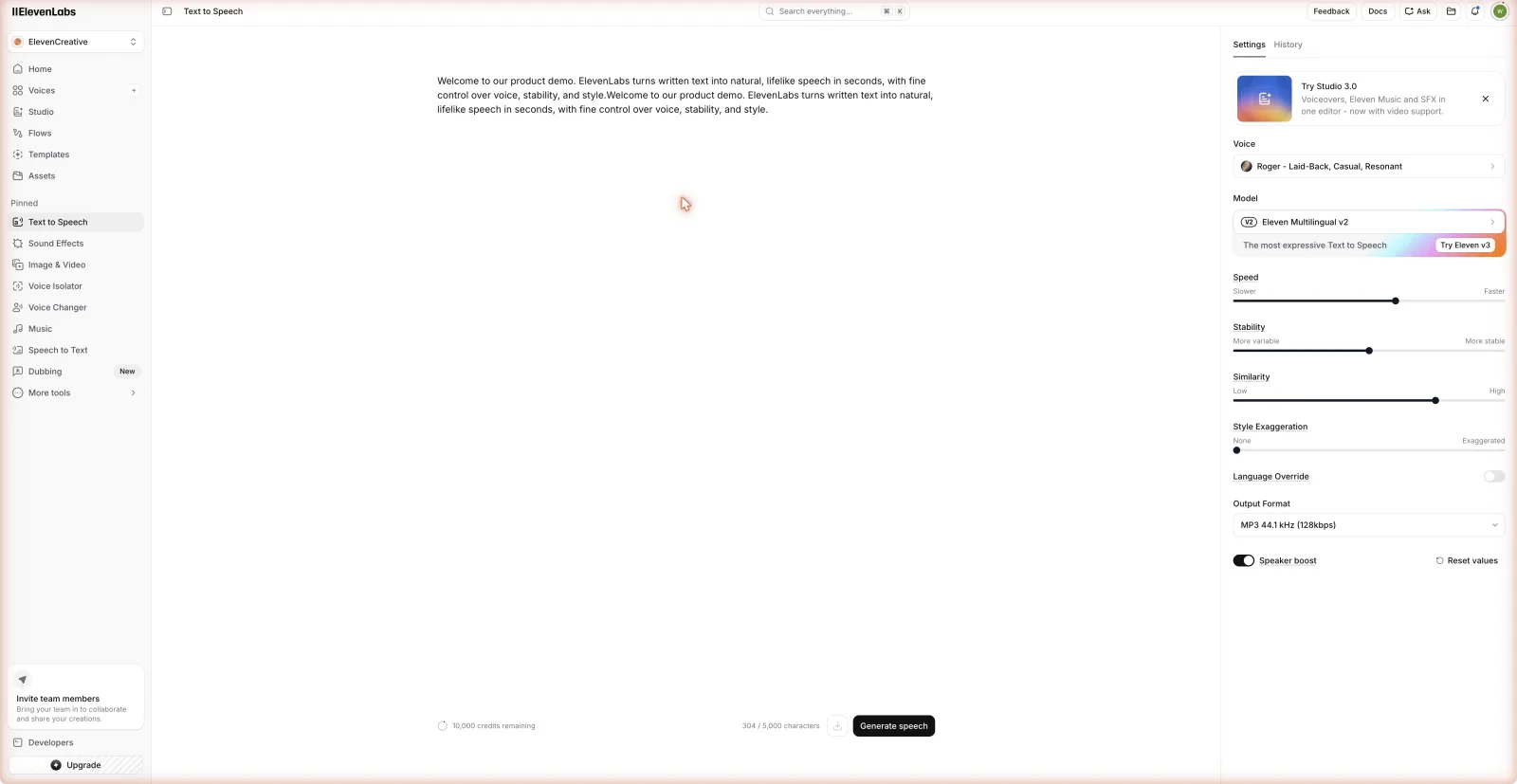
Why it works for audiobooks: ElevenLabs gives creators a realistic voice library, cloning options, and a platform that can handle long-form narration better than most general TTS tools. For fiction, voice style and emotion matter. For nonfiction, clarity and pacing matter. ElevenLabs is strong in both directions if you choose the voice carefully.
Pricing and workflow note: Starter is useful for testing commercial narration, but serious audiobook production usually needs a larger credit budget. Creator is the more natural tier when you want Professional Voice Cloning or recurring long-form output. Pro and higher tiers make more sense for studios, publishers, localization teams, and developers.
Best for: indie authors, serialized fiction creators, audiobook producers, course creators, multilingual narration, and creators who want a voice that can carry long chapters.
Limits: You still need editing. AI narration can misread names, overdramatize dialogue, or flatten emotion in subtle scenes. Budget also matters because a full audiobook can require many generation passes.
Choose ElevenLabs if: voice quality is your main concern and you want a tool that can grow from a test chapter to a full audiobook pipeline.
For adjacent comparison, see our ElevenLabs alternatives guide.
If you are deciding between ElevenLabs and a creator-focused voice/video workflow, our ElevenLabs vs LOVO comparison is useful for audiobook creators who also publish trailers, shorts, or social clips.
2. Murf AI
Murf AI is a strong choice for audiobook-adjacent narration where structure, review, and production workflow matter. It is not always the first pick for emotional fiction, but it fits business books, training books, educational series, internal learning libraries, and polished explainer narration.
Murf is built around a studio-style voiceover workflow. Teams can work with scripts, pacing, voices, and review cycles in a more controlled environment than a simple TTS box. That makes it attractive for organizations that produce repeatable narration rather than one-off creative audio.
The Murf pricing page is JavaScript-rendered in this collector, so this article avoids hard-coding current plan numbers. Check the official pricing page before planning a long audiobook project. Murf also has a Murf API, which can matter for teams that need scalable narration.
Why it works for audiobooks: Murf's strength is production discipline. If your audiobook is actually a training manual, product education series, company handbook, or nonfiction learning asset, Murf's studio workflow can be more useful than a voice model alone.
Pricing and workflow note: Murf is easiest to justify when the workflow saves production time. If you need team review, consistent pronunciation, and a controlled narration process, the subscription can be part of the production system. If you only need one emotional fiction narrator, compare output quality carefully against ElevenLabs.
Best for: business books, e-learning narration, nonfiction explainers, corporate audio libraries, agencies, and teams that care about review workflow.
Limits: Murf may not be the most expressive choice for character-heavy fiction. If your book depends on dramatic acting, emotional shifts, or distinct character voices, test before committing.
Choose Murf if: your audiobook project is structured, educational, commercial, or team-produced.
3. Speechify
Speechify is different from the other tools in this guide. It is best understood as a listening and accessibility product, not a production audiobook studio. That does not make it irrelevant. Many users searching for TTS for audiobooks simply want books, drafts, PDFs, or long documents read aloud.
The official Speechify pricing page lists Free and Premium at $29/month. Premium includes natural voices, 60+ languages, faster listening, Scan & Listen, summaries, integrations, voice typing, AI podcasts, and Voice AI Assistant. Those features are useful for readers, students, authors reviewing drafts, and accessibility users.
Why it works for audiobooks: Speechify is strong for consuming text. If you want to listen to a manuscript while walking, review a PDF as audio, or turn web articles into a private listening queue, Speechify is more convenient than a production TTS platform.
Pricing and workflow note: Speechify Premium is easier to evaluate as a productivity subscription than as an audiobook production cost. It can help authors proof-listen to drafts, but it should not be treated as the default tool for publishing a commercial audiobook unless the specific Studio and commercial rights fit your use case.
Best for: personal audiobook-style listening, accessibility, students, authors reviewing drafts, busy professionals, and users who want mobile reading support.
Limits: Speechify is not the strongest choice for exported, commercial, fully produced audiobook narration. Use it when the listener is you, or when accessibility and reading support are the main goal.
Choose Speechify if: you need to listen to books and documents, not produce a finished audiobook product.
4. WellSaid Labs
WellSaid Labs is a strong option for professional narration, training content, and organizations that need licensed voices with business controls. It is especially relevant for publishers, L&D teams, and brands that need a polished voiceover system more than a casual creator tool.
The official WellSaid pricing page lists a free 7-day Trial, Creative at $50/month per user billed annually or $55 month to month, Business at $160/month per user billed annually, and Enterprise custom. Creative includes commercial usage rights, English voices and accents, MP3 downloads, and annual download limits. Business adds team workspace features, collaboration, pronunciation libraries, access controls, expanded export formats, Adobe integrations, and larger usage allowances.
Why it works for audiobooks: WellSaid is useful when "audiobook" means professional narrated educational material, nonfiction content, brand-controlled audio, or internal learning libraries. Its positioning around licensed voices, business use, and governance is a good fit for teams that want fewer legal and operational surprises.
Pricing and workflow note: WellSaid is not the cheapest option, but its value is predictability. If legal review, commercial rights, and voice licensing matter, the higher per-user pricing may be easier to justify than a lower-cost creator tool.
Best for: business audiobooks, training libraries, professional narration teams, commercial nonfiction, regulated industries, and teams that want licensed voices.
Limits: It is less flexible for creator experimentation, character work, and multilingual fiction. Solo authors on a tight budget may find it expensive.
Choose WellSaid Labs if: you need professional, brand-safe narration with team controls and clear commercial usage rights.
5. Amazon Polly
Amazon Polly is the developer option in this list. It is not designed like a creator studio, but it can be useful for apps, automated audiobook pipelines, accessibility products, publishing platforms, or high-volume narration systems.
The official Amazon Polly pricing page uses a usage-based model. Exact cost depends on voice type, character volume, region, and usage. For a creator producing one book, that model can feel more complex than a monthly subscription. For a developer building a system that converts thousands of documents or chapters into audio, usage-based pricing can be the right structure.
Why it works for audiobooks: Polly is reliable infrastructure. It supports programmatic TTS generation, integrates with AWS workflows, and can be useful when you need repeatable production at scale rather than a hand-edited creator interface.
Pricing and workflow note: Model the total character count before using Polly for audiobook production. Audiobooks are long, and small per-character costs add up. You also need engineering, storage, chapter processing, file naming, and QA around the generated audio.
Best for: developers, accessibility products, publishing platforms, internal document-to-audio systems, and high-volume narration workflows.
Limits: Polly is not the best choice for a solo author who wants a beautiful narrator today. It requires more setup and does not provide the same creator-friendly experience as ElevenLabs, Murf, or WellSaid.
Choose Amazon Polly if: you need TTS as infrastructure, not a creative audiobook studio.
How to Choose the Right TTS for Audiobooks
Use the manuscript, audience, and distribution plan to choose the tool.
- Fiction, memoir, and narrative nonfiction: start with ElevenLabs because voice realism and listener comfort matter most.
- Business books and training material: compare Murf and WellSaid Labs because production control and commercial rights matter.
- Personal listening and draft review: choose Speechify because it is built for reading, mobile listening, and accessibility.
- Large-scale automated audio: choose Amazon Polly if you have engineering support.
- Podcast-style audiobook projects: compare this list with our best TTS for podcasts guide.
- Migration from an older TTS platform: compare current audiobook tools with our PlayHT replacement options before moving a long-form back catalog.
Before producing the full book, generate one complete chapter. Listen on headphones, phone speakers, and in a car. Mark mispronunciations, awkward pauses, emotional mismatches, and pacing issues. If the voice still feels pleasant after 30 minutes, it is more likely to work across a full audiobook.
Audiobook Rights, Distribution, and Disclosure
AI narration is not only a production choice. It can also affect rights, distribution, and listener trust.
Before publishing, check whether your destination allows AI-narrated audiobooks, requires disclosure, or has audio mastering standards. Some platforms may treat synthetic narration differently from human narration. You should also confirm that the TTS provider allows commercial use, paid distribution, ads, subscriptions, and derivative formats.
For paid audiobooks, keep records of the tool, plan, voice, generation date, commercial rights, and any disclosure language you use. This is especially important if you work with clients, publishers, or licensed material.
Chapter Production Workflow
A practical AI audiobook workflow looks like this:
1. Prepare the manuscript with consistent chapter headings, speaker labels, and pronunciation notes. 2. Generate one chapter with two or three candidate voices. 3. Listen for fatigue, pacing, pronunciation, and emotional mismatch. 4. Create a pronunciation list before generating the rest of the book. 5. Export chapters with consistent filenames and audio settings. 6. Review every chapter before distribution. 7. Save plan, rights, voice, and disclosure notes with the project.
This workflow is slower than pasting a manuscript into a TTS box, but it prevents the most expensive mistake: discovering after a full generation pass that the voice cannot carry the book.
Audiobook production overlaps with broader narration and reading-support workflows. Use best AI narration software if you need a narrator for multiple content formats, and text-to-speech for accessibility if listener support and readability are the main goals.
Frequently Asked Questions
What is the best TTS for audiobooks overall?
ElevenLabs is the best overall choice for most audiobook creators because it combines realistic AI voices, voice cloning, long-form narration potential, commercial plans, and API access. Murf and WellSaid are stronger for structured business narration, while Speechify is better for personal listening.
Can I publish an audiobook made with AI text-to-speech?
Sometimes, but you need to check the rules of your distribution platform and the commercial rights of your TTS plan. Some channels may require disclosure or have specific audio quality requirements.
Which TTS tool is best for fiction audiobooks?
ElevenLabs is the safest first choice for fiction because voice realism, emotion, and long-form listening comfort matter more than workflow features. Test a full chapter before generating the whole book.
Which TTS tool is best for nonfiction audiobooks?
ElevenLabs, Murf, and WellSaid Labs are all good options depending on the tone. ElevenLabs is stronger for natural narration, Murf is better for structured production, and WellSaid is stronger for professional brand-safe narration.
Is Speechify good for creating audiobooks?
Speechify is excellent for listening to books, PDFs, articles, and drafts. It is not the strongest default choice for producing a commercial audiobook, unless your specific plan and workflow support the rights and exports you need.
How much does AI audiobook narration cost?
Cost depends on character count, generation retries, plan limits, commercial rights, and editing time. A full audiobook usually requires more than a quick demo plan because you may regenerate sections, test voices, and edit chapters.
Do I still need to edit AI-generated audiobook narration?
Yes. You should review every chapter for pronunciation, pacing, awkward pauses, repeated lines, emotional mismatch, and audio consistency. AI TTS reduces recording time, but it does not remove editing and quality control.
What is the best TTS for audiobook developers?
Amazon Polly and ElevenLabs are strong options for developers. Polly is better for AWS-based infrastructure and usage-based systems, while ElevenLabs is stronger when voice quality and creator-friendly tools matter.
Short answer: ElevenLabs is the best TTS for audiobooks for most creators, Murf is best for structured business narration, Speechify is best for personal listening, WellSaid Labs is best for professional brand-safe narration, and Amazon Polly is best for developer-scale audiobook pipelines.